Rights claims, built on the record.
Police misconduct, prisoner rights, housing and disability discrimination and speech claims depend on early notices, records requests and a careful incident record. FirmsVault keeps each of them on the matter with the dates that protect the claim.
Civil Rights work, recorded as it happens
Claims against government actors and others for violations of constitutional and statutory rights: police misconduct, prisoner rights, housing discrimination, disability access and First Amendment claims. Work centres on the incident, evidence preservation and records requests, government claim notices and grievance exhaustion, immunity motions, discovery and resolution.
A workspace that watches the practice
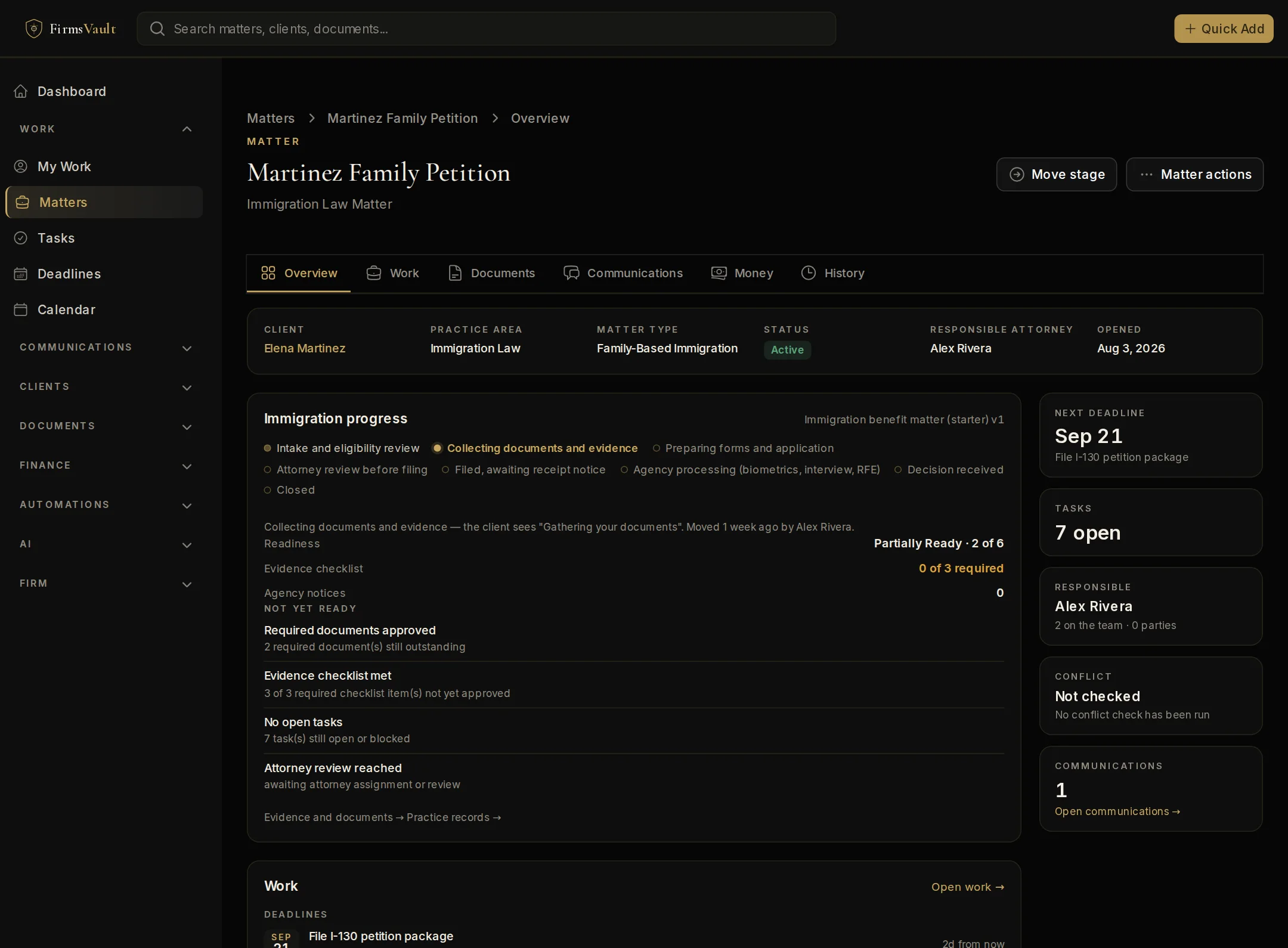
Every Civil Rights matter the firm is working sits on one practice workspace: what needs attention, what is due, who carries the work and what is still missing.
Practice figures
- Claim notice deadlines in 30 days
- Records requested, not received
- Claim notices and grievances open
- Motions pending
- Court dates in the next 30 days
What it flags
- Government claim notice date has passed
- Government claim notice due
- Claim notice date not confirmed
- Grievance or exhaustion deadline closing
- Grievance or exhaustion deadline has passed
Matter types
- Disability Access (ADA)
- First Amendment / Voting Rights
- Housing Discrimination
- Other Civil Rights Matter
- Police Misconduct / Excessive Force
- Prisoner Rights
Automation starters
- Check for a government claim-notice or grievance deadline
- Government claim notice coming due
What the client sees
The starter workflow's client-facing stages. The Client Portal shows these words, never the firm's internal steps; the firm can rename or reorder them.
- Getting started
- Securing the evidence
- Evaluating your case
- Case filed
- Exchanging information
- Resolution
- Complete
Court forms
Civil rights claims often begin with a government claim notice or grievance whose form is set by the public entity. Classify the notices your firm uses in the Legal Library; pleadings are firm-drafted.
- Section 1983
- The federal statute allowing suits for rights violations by state and local officials.
- Qualified immunity
- A defense shielding officials unless they violated clearly established law.
- Monell liability
- Liability of a local government for its own policy or custom.
- Exhaustion (PLRA)
- Prisoners must use available grievance procedures before suing.
Workflows, checklists, deadline guidance and automation starters are starting points for attorney review, not legal advice. FirmsVault does not calculate legal deadlines or file with courts or agencies. Availability of some capabilities depends on your plan and configuration.